
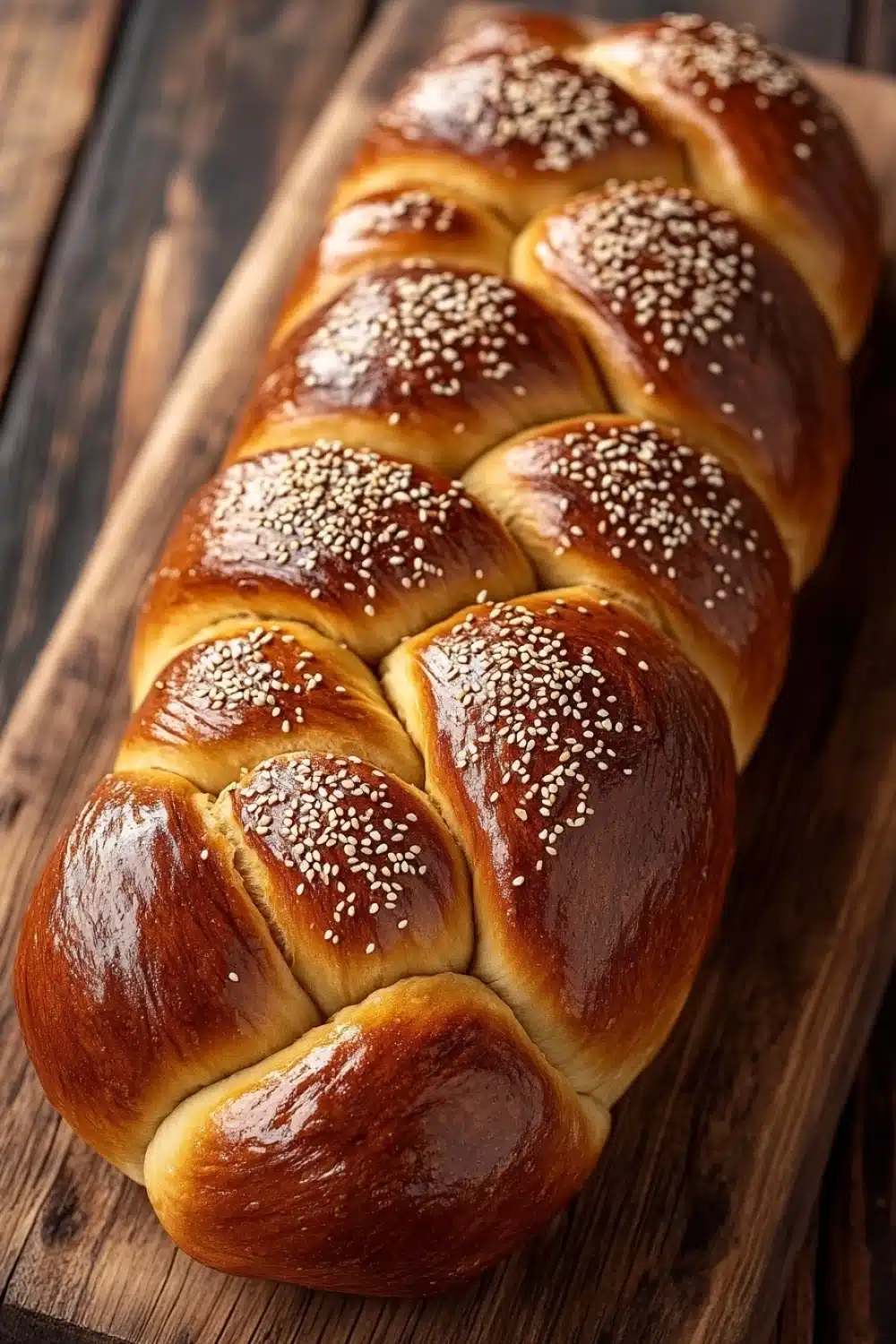
Let’s get braiding.
The kitchen fills with a comforting warmth as the dough rises, doubling in size—a soft, pillowy promise of what’s to come. The scent of honey and yeast mingles, teasing your senses and stirring memories of cozy Shabbat dinners and slow Sunday mornings.
This isn’t just bread. It’s a ritual. Kneading the dough by hand, feeling it transform from shaggy to silky smooth, is my favorite kind of therapy. There’s something about the rhythmic push and fold that sets the tone—an old-school dance between flour and fingertips.
By the time the loaf emerges golden and glossy, braided tight with sesame seeds sparkling atop, you know you’ve baked more than just bread. You’ve made a statement, a centerpiece, a slice of tradition worth savoring.
If you’re looking to add a unique twist to your dinner, try making a delicious challah bread wreath that’s perfect for festive gatherings.
Why Baking Classic Challah Bread Rocks in Real Life
- Nothing beats the smell of fresh challah wafting through your kitchen—instant cozy vibes and serious weekend mood boost.
- Slice it thick with butter or dunk into your favorite stew; this bread’s soft, fluffy texture soaks up flavors like a champ.
- Mastering the braid? It’s like therapy—kneading and weaving dough beats scrolling on your phone any day.
- Perfect for special occasions or just jazzing up your breakfast routine—because who says challah is only for holidays?
- Leftovers? Freeze slices individually and pop them in the toaster for a quick, homemade upgrade to your usual bread game.
Classic Challah Bread
A traditional Jewish braided bread with a slightly sweet flavor and soft, fluffy texture. Perfect for Shabbat or any special occasion.
- Prep Time: 30 minutes
- Cook Time: 30 minutes
- Total Time: 3 hours
- Yield: 12 slices
Ingredients
4 cups all-purpose flour, plus extra for dusting
1/4 cup granulated sugar
2 1/4 teaspoons active dry yeast (1 packet)
1 teaspoon salt
1 cup warm water (about 110°F)
1/4 cup vegetable oil
2 large eggs
1 large egg yolk
1 tablespoon honey
1 tablespoon water (for egg wash)
1 tablespoon sesame seeds
Instructions
In a small bowl, combine the warm water, sugar, and active dry yeast. Stir gently and let sit for 5 to 10 minutes until foamy.
In a large mixing bowl, whisk together the flour and salt.
In a separate bowl, whisk together the eggs, egg yolk, vegetable oil, and honey.
Add the yeast mixture and the egg mixture to the flour mixture. Stir with a wooden spoon until a shaggy dough forms.
Turn the dough out onto a lightly floured surface and knead for about 10 minutes until smooth and elastic. Add small amounts of flour if the dough is too sticky.
Place the dough in a lightly oiled bowl, cover with a clean kitchen towel or plastic wrap, and let rise in a warm place for 1 to 1.5 hours, or until doubled in size.
Punch down the dough and turn it out onto a floured surface. Divide the dough into three equal portions.
Roll each portion into a long rope, about 16 inches long. Pinch the ends together and braid the three ropes tightly.
Place the braided loaf on a parchment-lined baking sheet. Cover loosely with a towel and let rise for another 45 minutes until puffy.
Preheat the oven to 350°F (175°C).
In a small bowl, whisk together the egg wash (egg yolk and 1 tablespoon water). Brush the entire loaf with the egg wash.
Sprinkle sesame seeds evenly over the top of the loaf.
Bake the challah for 25 to 30 minutes, or until golden brown and the loaf sounds hollow when tapped on the bottom.
Remove from the oven and let cool completely on a wire rack before slicing.
Explore more:
Breakfast Recipes
Mastering Classic Challah: From Dough to Gold
The Salt vs. Sugar Tug-of-War: Why Your Challah’s Flavor Hangs in the Balance
I once tried skipping the sugar in my challah recipe, thinking it was just a minor player. Big mistake. Sugar isn’t just for sweetness; it’s the yeast’s favorite snack—feeding those little beasties to get the dough puffing and lively. Without it, you end up with a loaf that’s as flat as a pancake’s less exciting cousin.
Salt, on the other hand, is the dough’s strict teacher. It tightens gluten strands, adds punch, and keeps yeast from running wild. Too much salt? Your dough’s a stubborn mule. Too little? A slack, bland mess. Balancing these two is like tuning a guitar—get it off by a hair, and the whole jam session is off-key.
So here’s my two cents: never ditch the sugar, and measure salt with a hawk’s eye. That harmony is what gives challah its subtle sweetness and that signature tender crumb.
Swapping Ingredients? Play It Like a Pro
Sometimes life throws curveballs: no vegetable oil, no honey, or you want to toss in a gluten-free twist. No sweat.
Vegetable oil is your neutral buddy—swap it with light olive oil or even melted coconut oil if you’re feeling adventurous. Just keep flavors mild; you want challah, not a punch in the mouth.
Honey’s role? It adds that golden hue and slight chew. Maple syrup or agave nectar can slide in seamlessly—just watch that your dough doesn’t get too sticky. I once swapped honey for molasses, thinking I was being slick—ended up with a loaf darker than a midnight train and a slightly bitter edge. Lesson learned.
For gluten-free rebels: use a blend of gluten-free flours with xanthan gum to mimic that stretch and bounce. Challah won’t braid quite the same, but hey—no one said you can’t break the mold.
When Your Challah Flops: Troubleshooting the Usual Suspects
—Dough too sticky? That’s the yeast partying too hard or the humidity cranking up the flour’s moisture. Sprinkle flour sparingly, knead with patience. No throwing in half a cup all at once. Slow and steady wins the stretch.
—Bread too dense? Maybe your yeast went kaput or the dough didn’t rise long enough. Yeast is finicky—expired packets are dead weight. Also, don’t rush the rising. I’ve waited an extra 30 minutes and seen miracle poofs.
—Braids unraveling mid-bake? Tighten your ropes! Pinch those ends like your life depends on it. If they loosen, a quick dab of water or egg wash acts like glue.
—Crust too pale? Your egg wash might be the culprit. Whisk that yolk with a splash of water and brush generously. Skip this, and you get a sad, pale loaf. Sesame seeds? Sprinkle after the wash for that nutty crunch and visual zing.
Challah Bread FAQs
- Can I use active dry yeast straight from the fridge?
- Nope! It’s best to proof it in warm water with sugar first to wake those yeasty fairies up—otherwise your dough might just sulk and not rise.
- Why does my challah come out dense sometimes?
- That’s usually a sign of under-kneading or not letting it rise enough. Kneading builds the gluten network—think of it like training muscles—and a proper rise gives those strands time to trap the air bubbles you crave. Patience here pays off with soft, fluffy bread.
- Is it okay to use honey instead of sugar?
- Absolutely! Honey adds a nice depth and mild sweetness that sugar can’t quite match. It also helps with browning during baking, giving your loaf that inviting golden crust.
- Can I freeze homemade challah?
- Yes, you can freeze it for up to three months. Just wrap it tightly in plastic and toss it in the freezer. When you’re ready, let it thaw at room temperature and slice as usual. Pro tip: Warm it slightly before serving for that fresh-baked vibe.
- Should I brush the egg wash before or after the second rise?
- Brush it right before baking, after the second rise. Doing it too early can weigh down the dough or cause the wash to bake into a crusty film, which is not what you want.