
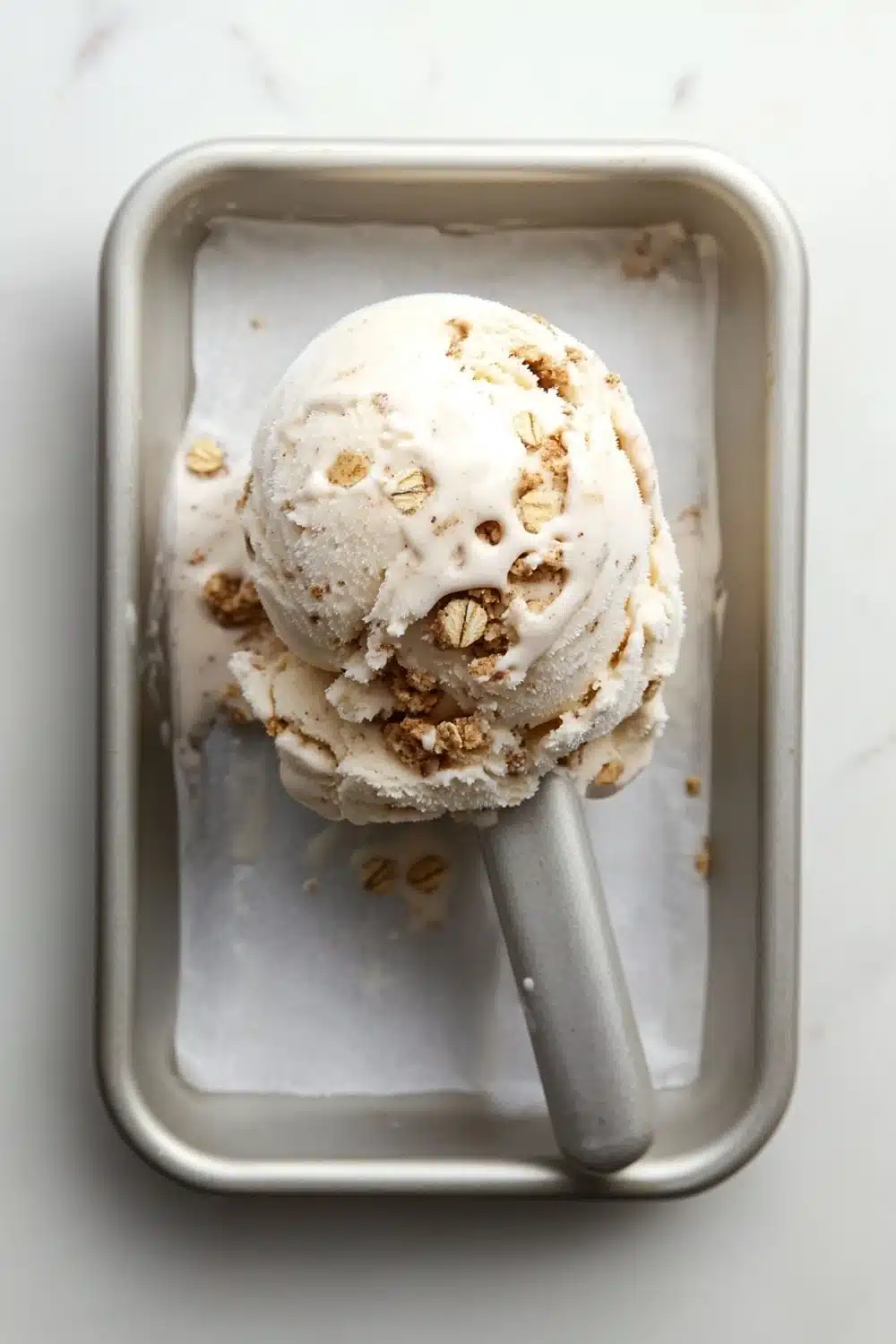
Cookie craving? Check.
Picture this: a quiet kitchen with the faint hum of the ice cream maker spinning, the warm scent of cinnamon and oats curling through the air like a cozy blanket on a chilly evening. This isn’t just any dessert—it’s a scoop of nostalgia wrapped in creamy goodness, where chewy oatmeal cookie chunks play hide-and-seek with velvety vanilla custard.
I’ve always been a sucker for that perfect bite—the one with just enough chew and a whisper of spice. Baking the cookies fresh before folding them into the ice cream base is my secret weapon; it keeps the texture spot-on and the flavor punchy. No soggy bits here, just that satisfying contrast that keeps you coming back for more.
Trust me, once you try this oatmeal cookie ice cream, your freezer will never be the same.
For a delightful twist, try pairing your oatmeal cookie ice cream with the story of When a Baked Oatmeal Cookie and Kate Met on a Rainy Afternoon.
Real-Life Perks of Making Oatmeal Cookie Ice Cream
- Whipping this up means you’re never far from a nostalgic scoop—think cozy kitchen vibes and that classic cookie crunch with every bite.
- Perfect for summer hangouts or family dinners when you want to impress without busting your budget or sanity.
- Making cookie dough AND ice cream from scratch? You become the unofficial neighborhood ice cream hero, no kidding.
- It’s a crowd-pleaser that doubles as a conversation starter—because who doesn’t want to know your secret to mixing cookies into ice cream?
- And honestly, when else do you get to enjoy cookies that are just soft enough inside, chilled perfectly by creamy ice cream? It’s a win-win for stress relief and taste buds alike.
Oatmeal Cookie Ice Cream

A creamy homemade ice cream infused with the warm flavors of classic oatmeal cookies, featuring chunks of chewy oatmeal cookies folded throughout for a delightful texture and taste.
- Prep Time: 20 minutes
- Cook Time: 10 minutes
- Total Time: 6 hours 30 minutes
- Yield: 8
Ingredients
1 1/2 cups old-fashioned rolled oats
1 cup all-purpose flour
1/2 teaspoon baking soda
1/2 teaspoon ground cinnamon
1/4 teaspoon salt
1/2 cup unsalted butter, softened
1/2 cup packed light brown sugar
1/4 cup granulated sugar
1 large egg
1 teaspoon vanilla extract
2 cups heavy cream
1 cup whole milk
3/4 cup granulated sugar
5 large egg yolks
1 teaspoon vanilla extract
Instructions
Preheat the oven to 350°F (175°C). Line a baking sheet with parchment paper.
In a medium bowl, whisk together the rolled oats, flour, baking soda, cinnamon, and salt.
In a large bowl, beat the softened butter, light brown sugar, and granulated sugar together until creamy and smooth.
Add the egg and 1 teaspoon vanilla extract to the butter mixture and beat until combined.
Gradually add the dry ingredients to the wet ingredients, mixing until just combined.
Drop tablespoon-sized scoops of cookie dough onto the prepared baking sheet, spacing them about 2 inches apart.
Bake for 8 to 10 minutes, or until the edges are golden brown but the centers are still soft.
Remove from the oven and let the cookies cool completely on a wire rack.
In a medium saucepan, combine the heavy cream, whole milk, and 3/4 cup granulated sugar. Heat over medium heat until the mixture is hot and sugar is dissolved, but do not boil.
In a separate bowl, whisk the egg yolks until smooth.
Slowly pour about 1 cup of the hot cream mixture into the egg yolks, whisking constantly to temper the yolks.
Pour the tempered egg yolks back into the saucepan with the remaining cream mixture.
Cook over low heat, stirring constantly with a wooden spoon or heatproof spatula, until the mixture thickens and coats the back of the spoon (about 170°F or 77°C). Do not let it boil.
Remove from heat and stir in 1 teaspoon vanilla extract.
Pour the custard through a fine-mesh sieve into a clean bowl to remove any cooked egg bits.
Cover the custard with plastic wrap, pressing it directly onto the surface to prevent a skin from forming. Chill in the refrigerator for at least 4 hours or overnight.
Once chilled, churn the custard in an ice cream maker according to the manufacturer’s instructions.
Roughly chop the cooled oatmeal cookies into small chunks.
During the last 5 minutes of churning, add the oatmeal cookie chunks to the ice cream to mix evenly.
Transfer the ice cream to an airtight container and freeze for at least 2 hours to firm up before serving.
Explore more:
Breakfast Recipes
Mastering Oatmeal Cookie Ice Cream: From Dough to Dream
The Cookie Crux: Why Texture Makes or Breaks It
Picture this: You’re biting into a scoop of oatmeal cookie ice cream, expecting that satisfying chew of cookie amidst the creamy coolness—and instead, it’s soggy mush. Cringe, right? That’s the pitfall many fall into when folding cookie chunks into ice cream. The trick? Bake your oatmeal cookies just right—edges golden but centers still a bit soft. This way, they hold their shape but stay chewy, avoiding that ‘sad sog’ syndrome.
Chunk size matters, too. Chop cookies into uneven, rustic pieces—think “chunky monkey” style—not perfectly uniform crumbs. This gives you pockets of cookie goodness and texture contrast. Tossing these chunks in right at the end of the churning cycle keeps them suspended without turning them into sad little flakes. It’s all about timing and size—nail these, and you’re onto a winner.
Custard Conundrums Solved: The Why Behind Custard Custard
Here’s the scoop—custard base is what separates so-so ice cream from the real deal. The egg yolks act as natural emulsifiers, lending the creamy mouthfeel and body that screams “homemade care.” But it’s a tightrope walk: overheat and you get scrambled eggs; underheat, and your custard is runny and bland. The magic temp is around 170°F (77°C), when the mixture thickens enough to coat the back of a spoon—what old-school cooks call “nappe.”
Tempering the yolks with hot cream is non-negotiable—dumping them in raw leads to curdles faster than you can say “churn.” Also, don’t skip straining the custard—those rogue cooked bits ruin the smoothness. Trust me, this step is the difference between a silky scoop and a gritty letdown.
Fixing the Flops: When Ice Cream Goes South
Ever had ice cream that’s icy, too hard to scoop, or just plain bland? Been there. Here’s the lowdown:
- Icy Texture: Usually caused by insufficient fat or over-freezing. Our recipe’s heavy cream and egg yolks pack enough fat to keep things creamy, but don’t skip that 5-10 minute room temp thaw before scooping—nature’s way of softening the scoop.
- Too Hard to Scoop: Ice cream fresh out of the freezer can be rock solid. Don’t lose your cool—plan ahead and let it rest at room temp briefly. Or, try adding a tablespoon of vodka next time; the alcohol lowers freezing point without a boozy hit.
- Flavor Falls Flat: Vanilla extract is your MVP, but don’t stop there—those cinnamon-spiced oats in the cookies bring warmth and depth. If your base tastes dull, check your vanilla quality and don’t skimp on the cinnamon in the dough.
Remember, ice cream is a delicate dance of chemistry, timing, and ingredient love. When you get these right, you’re no longer just making a dessert—you’re crafting an experience.
Oatmeal Cookie Ice Cream FAQ
A: Eggs are pretty crucial here—they bind the dough and give the cookies their chewy heart. Skip ’em, and you risk crumbly, sad cookies that won’t hold up in the ice cream. I’d say nope, don’t ditch the eggs.
A: Absolutely yes. The chilling isn’t just a chill pill—it lets the custard thicken up, deepen in flavor, and ensures your ice cream churns into smooth bliss instead of icy shards. Patience is the secret weapon here.
A: You could, but quick oats tend to be too fine and mushy when baked; they won’t give you that satisfying chewy texture in your cookies. Old-fashioned oats have the bite and nuttiness that make these cookies sing.
A: Nah. The cookies soften once folded into the creamy ice cream, but that’s the charm—a little textural contrast with soft cookie chunks is the whole shebang.
A: You’ve got about two weeks before the texture and flavor start to fade. Just keep it airtight and don’t let it get freezer-burned. Easy peasy.