
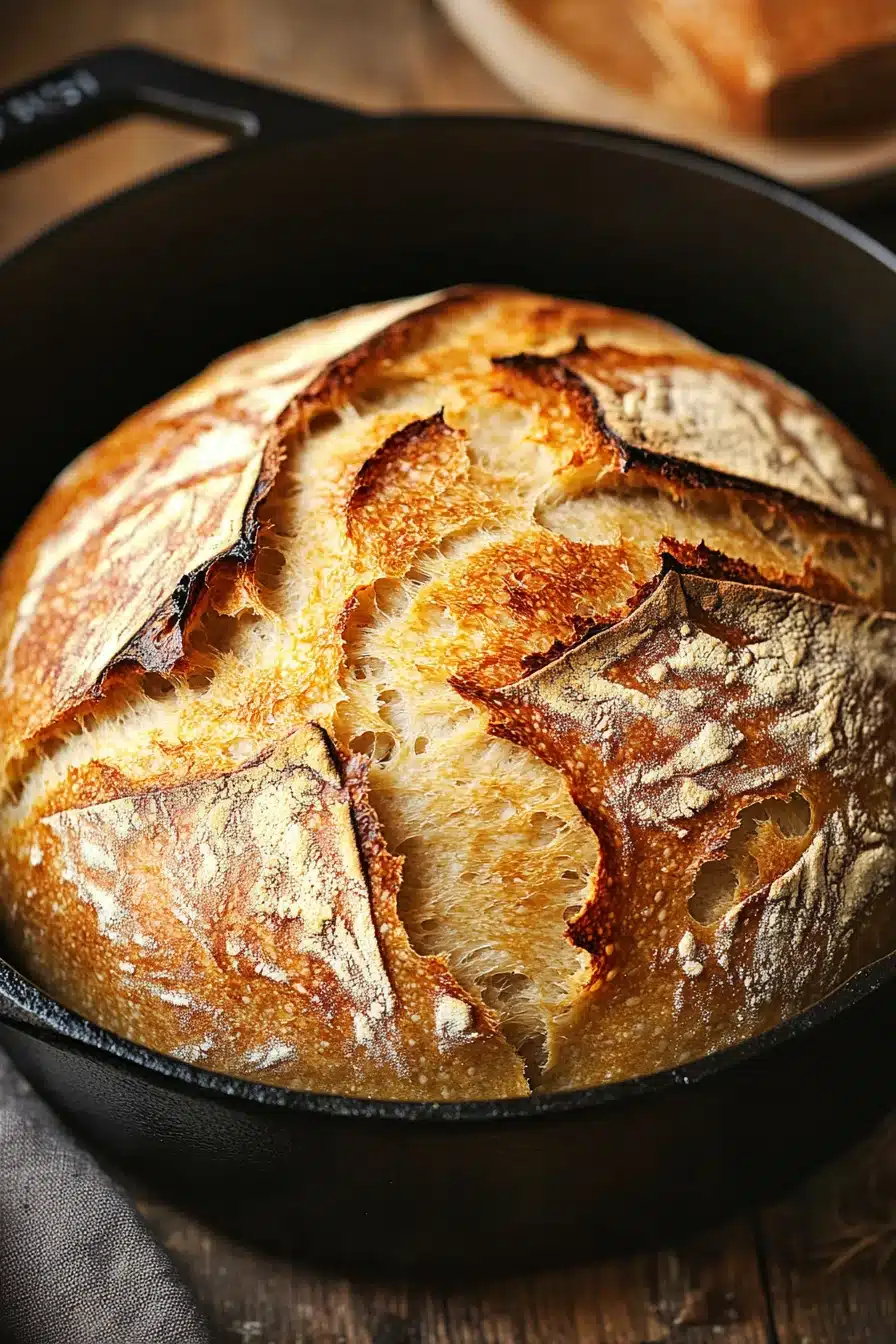
There’s something quietly satisfying about waking up to the smell of fresh bread, especially when you didn’t have to slave over the dough. This no knead bread baked in a cast iron Dutch oven is the kind of recipe that feels like a gentle nudge to slow down and enjoy the little moments.
Last weekend, I set the dough before bed, its shaggy texture barely clinging together, and left it to rest overnight. The next morning, the kitchen was filled with a faint, yeasty aroma that hinted at what was to come. Pulling the hot Dutch oven from the oven was a bit nerve-wracking—I usually hesitate just a second, worried I’ll drop it or burn myself—then the transformation began. The bread emerged with a crackly, golden crust that practically begged to be torn apart. I remember the first bite; the contrast between the crisp shell and the soft, airy inside was somehow more delicious because I hadn’t rushed it. It wasn’t perfect—there was a little unevenness in the shape—but honestly, that just made it feel more homemade.
- It’s wonderfully simple, requiring minimal hands-on time, which makes it almost effortless.
- The cast iron Dutch oven creates a crusty exterior that’s hard to beat, but it means you’ll need to be careful handling a very hot pot.
- The long rise time means you have to plan ahead, which can be a blessing or a challenge depending on your schedule.
- The rustic shape and texture might not be uniform, but that’s part of its charm.
If you’ve been intimidated by bread baking, this recipe might surprise you. It’s a quiet reminder that great bread doesn’t have to be complicated or quick—it just needs good timing and a little patience.
PrintNo Knead Bread in Cast Iron Dutch Oven
A simple and rustic no knead bread recipe baked in a cast iron Dutch oven, resulting in a crusty exterior and soft, airy interior. Perfect for beginner bakers and requires minimal hands-on time.
- Prep Time: 15 minutes
- Cook Time: 45 minutes
- Total Time: 12 hours 0 minutes
- Yield: 8
Ingredients
3 cups all-purpose flour
1/4 teaspoon instant yeast
1 1/4 teaspoons salt
1 1/2 cups warm water (about 110°F)
Instructions
In a large mixing bowl, combine 3 cups all-purpose flour, 1/4 teaspoon instant yeast, and 1 1/4 teaspoons salt.
Add 1 1/2 cups warm water to the dry ingredients and stir with a wooden spoon or spatula until a shaggy dough forms and all flour is incorporated.
Cover the bowl tightly with plastic wrap or a clean kitchen towel and let the dough rest at room temperature for 12 hours, or until the surface is dotted with bubbles and the dough has doubled in size.
After the dough has risen, lightly flour a clean work surface and turn the dough out onto it.
With floured hands, fold the dough over on itself once or twice to shape it into a rough ball. Do not knead.
Place the dough seam side down on a large piece of parchment paper and cover loosely with a kitchen towel. Let it rest for 30 minutes.
About 30 minutes before baking, place a 5 to 6-quart cast iron Dutch oven with its lid inside your oven and preheat to 450°F (230°C).
Carefully remove the hot Dutch oven from the oven. Using the parchment paper, lift the dough and place it into the Dutch oven.
Cover with the lid and bake for 30 minutes.
After 30 minutes, remove the lid and bake for an additional 15 minutes, or until the bread is deep golden brown and crusty.
Remove the bread from the Dutch oven and transfer it to a wire rack to cool completely before slicing.
Using a Dutch oven takes the guesswork out of creating a perfect crust, and you don’t need any fancy equipment—just a sturdy, oven-safe pot with a lid. I like serving this bread warm with butter and honey or alongside a cozy soup. Sometimes, I fold in a handful of herbs or swap out some white flour for whole wheat, though I haven’t tested all variations thoroughly. You could also sprinkle seeds on top before baking if you’re feeling adventurous.
FAQ
Can I use a different pot? A heavy oven-safe pot with a lid works, but cast iron is ideal for heat retention.
What if I forget to bake right after the rise? You can refrigerate the dough for a few hours, but let it come back to room temperature before baking.
Why does the bread need such a long rise? The slow fermentation develops flavor and texture without kneading.
Can I freeze the bread? Yes, wrapped tightly in plastic wrap and thawed at room temperature.
Give this no knead bread a try—it’s a quiet ritual that might just become your favorite weekend tradition.