
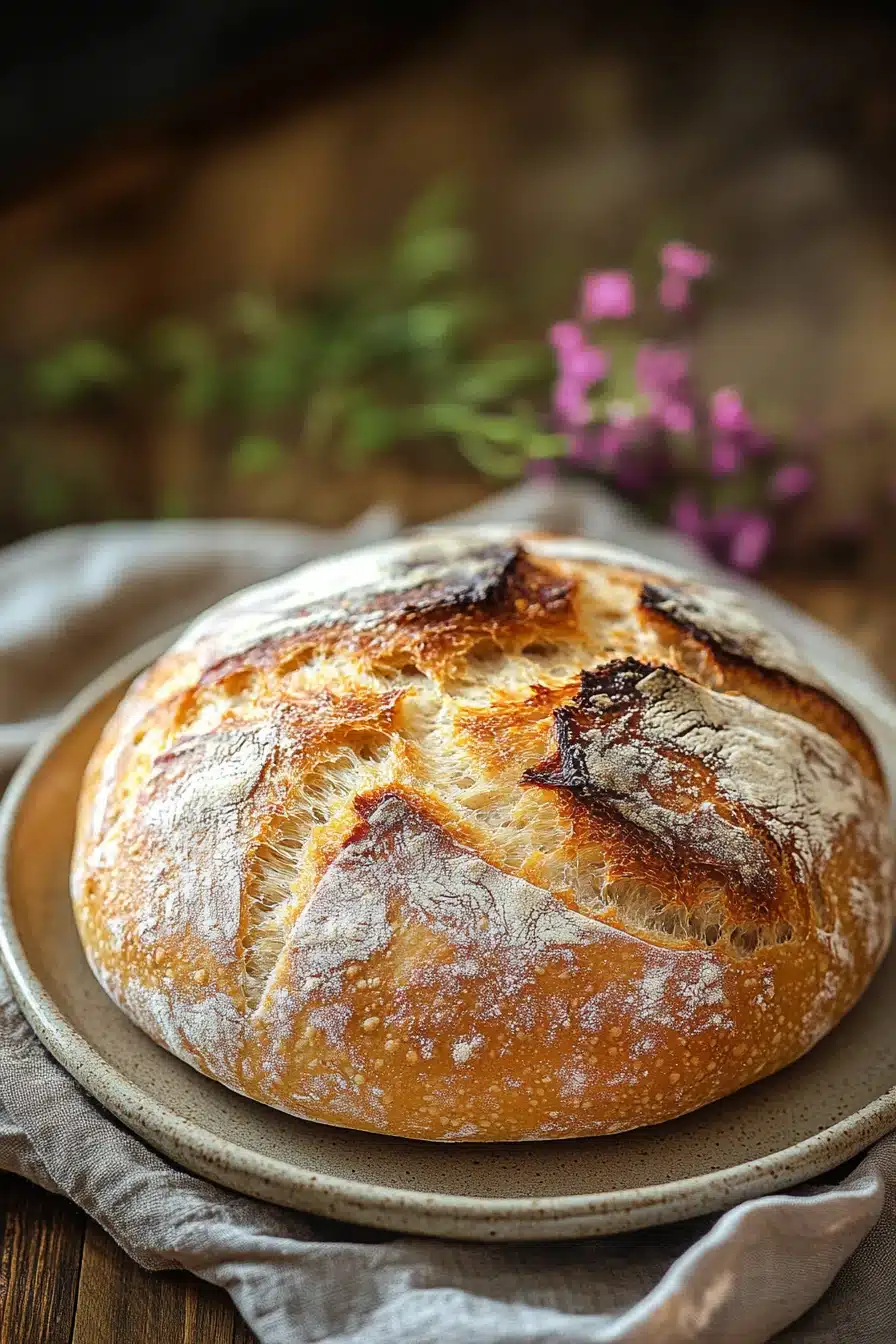
There’s something about the smell of fresh bread wafting through the house that turns an ordinary day into a little celebration. I remember the first time I tried this no knead bread recipe using active dry yeast — I was a bit skeptical. How could something that requires almost no effort taste so good? That afternoon, I found myself distracted by the rising dough, poking at it gently as bubbles formed across its surface. It wasn’t perfect, not by a long shot — I think I accidentally let it rise a bit longer than intended, and the crust was a little thicker than I wanted. Still, when I sliced into the loaf, the crumb was airy and chewy, and the crust crackled under my knife. Somehow, the simplicity made it feel like a small victory.
I usually don’t have much time to fuss with bread, so this method felt like a secret weapon. Just mix, wait, and bake, and you end up with something that feels fancy but is totally doable on a busy day. It’s the kind of recipe that invites you to slow down, even if just for a moment, without asking for much in return.
- The crust comes out beautifully crisp and golden, mimicking artisan bread without a bakery’s fuss.
- Minimal active dry yeast means no overpowering yeasty flavor — it’s balanced and mild.
- Hands-off preparation lets you focus on other things while the dough slowly does its work.
- It takes time, so don’t expect an instant loaf — patience is part of the process, and honestly, it’s kind of nice.
- Since there’s no kneading, it’s forgiving for beginners or those who’d rather not get their hands too sticky.
If you’re worried about timing, this recipe practically works around your schedule. Just mix it up in the evening, and by morning or afternoon, you’ll have a warm loaf waiting. And if you mess up a little — like I did with the rising — it’s still tasty, so don’t stress too much.
PrintNo Knead Bread with Active Dry Yeast

A simple and easy no knead bread recipe using active dry yeast that yields a crusty, artisan-style loaf with minimal effort.
- Prep Time: 15 minutes
- Cook Time: 45 minutes
- Total Time: 5 hours
- Yield: 8
Ingredients
3 cups all-purpose flour
1/4 teaspoon active dry yeast
1 1/4 teaspoons salt
1 1/2 cups warm water (about 110°F)
Instructions
In a large mixing bowl, combine the flour, active dry yeast, and salt.
Add the warm water to the dry ingredients and stir with a wooden spoon or spatula until a shaggy dough forms.
Cover the bowl tightly with plastic wrap or a clean kitchen towel and let it rest at room temperature for 12 to 18 hours, until the surface is dotted with bubbles and the dough has doubled in size.
Lightly flour a clean work surface and turn the dough out onto it. Fold the dough over on itself once or twice to shape it into a rough ball.
Place the dough seam side down on a large piece of parchment paper and cover it with a clean kitchen towel. Let it rise for 1 to 2 hours, until it has nearly doubled in size.
About 30 minutes before baking, place a heavy covered pot (such as a Dutch oven) in the oven and preheat to 450°F (230°C).
Carefully remove the hot pot from the oven. Using the parchment paper, lift the dough and place it into the pot. Cover with the lid and bake for 30 minutes.
Remove the lid and bake for an additional 15 minutes, until the bread is golden brown and crusty.
Remove the bread from the pot and let it cool on a wire rack for at least 1 hour before slicing.
Don’t worry about fancy equipment here. A heavy pot with a lid, like a Dutch oven or something similar, works perfectly to create the right steam for that crackling crust. I often serve this bread just sliced with butter or alongside soup, but sometimes I toast it and slather on jam. You can try folding herbs into the dough or swapping part of the flour for whole wheat, though I haven’t tested those tweaks extensively — just some food for thought.
FAQ:
Q: Can I use instant yeast instead?
A: You probably can, but the timing might shift a bit; the recipe is designed for active dry yeast.
Q: What if I can’t bake right away?
A: The dough can wait a bit longer, but too long and it might overproof — just keep an eye on those bubbles.
Q: How do I store leftovers?
A: Wrap the bread in a towel at room temp for a day or two; for longer, slice and freeze.
Ready to give this no-fuss bread a try? It’s one of those recipes that proves homemade doesn’t have to be complicated. Save it, print it, and maybe start your own little ritual with warm bread and quiet moments.